How a Toxic Upbringing Quietly Shaped My 14-Year Career


I almost didn’t write this. Reflecting on this topic meant confronting truths I had kept buried for a long time. Accepting that reality meant forcing myself to examine how I work and how I project confidence. Writing this felt like a point of no return.
This is a complex subject, shaped over more than three decades of my life. The way I handle emotions, work, and self-worth today didn’t form in isolation. It took root much earlier. Growing up was hard to say the least. My fragile, innocent mind knew the behaviour displayed at home by my parents was not normal. Yet, most of these behaviours have been so normalised in Indian society that people make money creating reels out of it, and we, as the audience, can only laugh at it, which is twisted. My mother wanted us (my brother and I) to win the goddamn race of life across every aspect. Non-stop comparisons with other students or random strangers who gave zero f**k about us but had to be pulled into the conversations, which somehow was supposed to motivate us! Every single morning, I witnessed firsthand how impatient and irritated my mom would get when my dad asked for extra money right before he left for the office.
A bit of a digression here. In India, it is considered normal for husbands to give a chunk of money to their wives for managing the monthly expenses. However, in my parents' case, my father withdrew all his money and gave it to my mom. Stating it out loud, a slow burn starts in my chest. The paradox of it all drives me crazy.
As an adult, when I started fighting back or standing up for myself, my parents failed to see or even think why I might be reacting like this and instead labelled themselves as the victims, circling the same dialogues like "we are not educated, we cannot speak English. That's why you talk to us like this." I knew then it was a moot point to argue with them because they would never understand what we had felt the entire time growing up.
"Growing up was hard" is the most understated line of this blog.
What I didn’t realise at the beginning of my career was how quietly these toxic traits had already begun shaping the way I showed up at work.
Early Patterns That Showed Up at Work
I have always struggled with impatience. I often jumped to the next exciting thing before completing the current one. This resulted in dissatisfaction and created a lengthy list of pending, unfinished tasks.
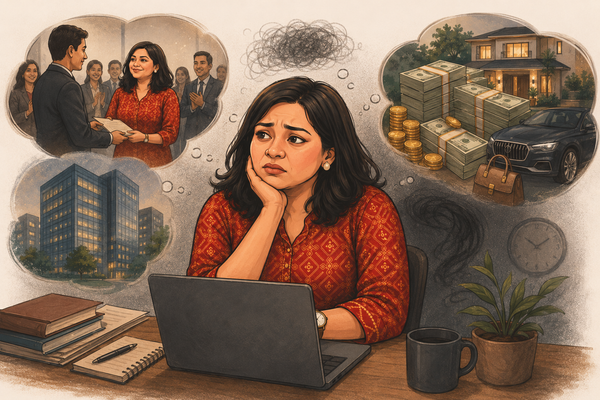
On the other hand, the efforts that I put into my work usually made me the centre of attention. However, internally, I felt very uncomfortable with it. I constantly struggled between working quietly and going above and beyond to get promoted quickly. I was hesitant to pause my progress, concerned that the company leaders might overlook me and I could fall behind my peers.
The two times I had a colleague reporting to me, I did not do a great job at all! The perfectionism trait in me made me push the expectations on them hard. I berated them for not doing a task the way they should have, sometimes on the office floor rather than in a meeting room. I just had to make a scene! I am ashamed to admit this, but I took pleasure when I saw their faces fall. It was the same way my mother could not stop herself once she lost control of her emotions. I constantly lost the battle to pull back my emotions, giving in to anger and frustration when a team member could not deliver according to my expectations. The worst part of it all? I never apologised to them, even when I regretted it.
Over time, these patterns stopped being invisible and began leaving consequences I could no longer ignore.
Moments That Made Me Reflect
I was unable to trust my peers or even my leaders when it came to sharing something. I tried to maintain tight control over the projects I was leading, which ultimately led to burnout and exhaustion.
I remember a recent conversation I had with my manager’s manager regarding my performance rating. I was prepared to get the highest rating, which had been a six-year streak in the current company. I had all my points jotted down if she asked me what rating I deserved. We join the Teams call, she is in the US, and I in India. The call starts with the usual conversation, and my nerves start to get the better of me. I never had my camera on for any of the meetings because it was never imposed, which is an advantage at times. She finally asked me what rating I was expecting that year, and I started rambling, confident that the verdict would be in favour. My face fell, and tears threatened to flow when my rating was disclosed.
She decided to reduce my rating due to this one single feedback: “Instead of providing solutions to a problem or trying to be a problem solver, you pinpoint and focus on faults and ask more questions”. This was a setback for me in many ways. This meant that I had to kiss my promotion goodbye and still had to prove myself through my work. My brain instantly labelled me as a victim, and I carried this sting for months to follow. I badmouthed her in front of my peers. Instead of improving on the feedback, I cancelled all my 1x1s with her, concluded that she was not my well-wisher, and that she wanted me to find another job.
Another incident I remember is from a couple of years back. I was leading yet another project, and there was an IT manager with whom I had to work on the project. The IT manager tried to communicate and make certain decisions, which were my responsibilities, and obviously did not sit well with me. This activity became so aggravated in my mind that I escalated this "issue" to his manager. I couldn't sleep because I feared losing control. I feared he would take over my project and make it his success story. My fear of confrontation stopped me from speaking with him directly on the matter. I could have seen it as a helping hand to reduce the burden on my plate.
These incidents forced me to confront a difficult truth: I am repeating a behavioural pattern I am very familiar with.
Looking back, these moments now feel less like isolated incidents and more like signals I had been avoiding. There is a bitter taste in my mouth. I could have done so many things differently. But how does one take the right path when all their life they have been conditioned to toxic traits from their family members or have been witnessing all the wrong behaviours which served as a model for their future behaviours? Is it even possible?
In my long & difficult journey towards rediscovering myself and rewiring the behavioural neural paths in my brain, I realised that it’s never too late to unlearn harmful patterns and build habits that lead to a more sustainable life and a healthier relationship with work. At the same time, staying out of old cycles often requires difficult, deliberate choices.
Things are starting to look better. The how — what I've actually been unlearning — needs its own post. Soon. I promise.
If you've made it this far, you've probably noticed something: fear is the engine underneath most of what I described. I'm untangling each one, slowly. I went deeper into one of them — fear of judgment — you can read it here: - From Fear of Judgment to Breaking the Victim Mindset
Healing may be slow, but every insight that I gain gives me a chance to choose differently next time.
If this post helped you, you can optionally support my writing with a coffee ☕.
Thanks for reading. See you in the margins.