
How I Started Unlearning My Parents' Patterns at Work (What Actually Helped)
One Friday with no meetings, I sat down and listed every task I had been avoiding for almost a year. I am not kidding when I say it took me the entire day. Three months later, 40% of those tasks are still pending — and I am still figuring out if that means I am failing.


A pattern that surfaced after my annual performance rating was reduced at work was that I began rescheduling all my calls at least twice, sometimes a few minutes before they were scheduled to start! I started neglecting the tasks on my mind, kept a mental check on the priority ones so they wouldn't get escalated further, and just kept moving forward in the hope that what I was doing was enough. I binge-watched series, I worked with my TV on for almost the entire time, and my cognitive ability was split between the demanding nature of the tasks and the latest K-drama that was on the TV. Numbness was the only thing that kept me sane. In all fairness, the conversations with my parents had already been limited for some years. However, the damage to my psyche and how I looked at work was already done way before I even realised.
This is part two of the "unlearning" series, where I dive into my journey of unlearning the patterns that I absorbed from my parents growing up and becoming the professional that I have always aspired to be.
Part 1 can be read here: How a Toxic Upbringing Quietly Shaped My 14-Year Career.
Whenever I would speak with my mom in that limited conversation space, I made sure to convey the amount of stress and the workload I had, how the job market had become unstable, and if I lost my job, how miserable our lives would become because we had no emergency savings. When I would speak with my colleagues, I would badmouth my managers, my leaders and how everything was unfair for me with so much work unloaded on me.
This was a common pattern for me in the months to come.
One day, as I was enjoying my evening tea, I received a call from one of the stakeholders about a task that had been overlooked for months. The stakeholder's tone was harsh and pointed. He warned about a possible escalation if things weren't resolved in a week. My entire body went numb, and I couldn't breathe. So many questions floated through my mind all at once. Why didn't I read the emails? If I get escalated, will my leaders trust me anymore? How many other things have I overlooked? I had absolutely forgotten about it because I was not tracking a single task; all important emails were just kept in flagged mode, with action taken for only a handful of them. Eventually, the pile had become so big that things started slipping through the cracks. I apologised to him profusely and promised to take care of it immediately.
I opened my mailbox in that instant and went through my flagged emails one by one, only to realise how many users were waiting for me to respond or take action.
After I closed my laptop that night, the thoughts remained in my head. Where am I heading with this? Why am I self-sabotaging my career? Do I want to get fired? I never got the answers that day, but one thing became clear: the life that I had unknowingly started living was like a slow leak under the sink, and something had to give.
These thoughts never left me for the next few days. The escalation did happen eventually, and my panic soared through the roof. I started backtracking through the days when this procrastination first started, analysed my behaviour with my therapist and then I realised with dismay who I was mimicking in my work.
The first realisation was that this is exactly what my mom did and continues to do whenever she has a self-serving agenda - like refusing to take responsibility for her grandson or lamenting about how costly everything has become whenever she feels we could ask her for money.
The second realisation was hard to reckon with. The actions that I was pursuing consciously every single day were inching me closer to becoming a version of the unhinged, deflector, and accountability-averse personality of my mother that I had vowed a long time ago to never become.
What Started to Help. And What Didn't.
The job market decided for me. It had worsened in a mere span of 12 months, with not a single callback from the companies where my profile would have been a great fit. So the work I'd been avoiding for a year was now the only path forward, and the only person who was going to do it was me.
The dreadful list
It was scary to list out every single task that was jotted in my notebook and process every unread email into an actionable item. However, one fine Friday when I had no meetings scheduled, I decided to create a simple template that looks good to the eye while allowing me to fill in the tasks that I should focus on for the upcoming week. I am not kidding when I say it took me the entire day to finish chalking up the tasks (big or small) I had been avoiding for almost a year! There was this one task that I was avoiding like the plague because my lack of knowledge in that area drove this overwhelming desire to push it out of my mind. However, when I did jot it down and break it into actionable items, it felt a little less scary.
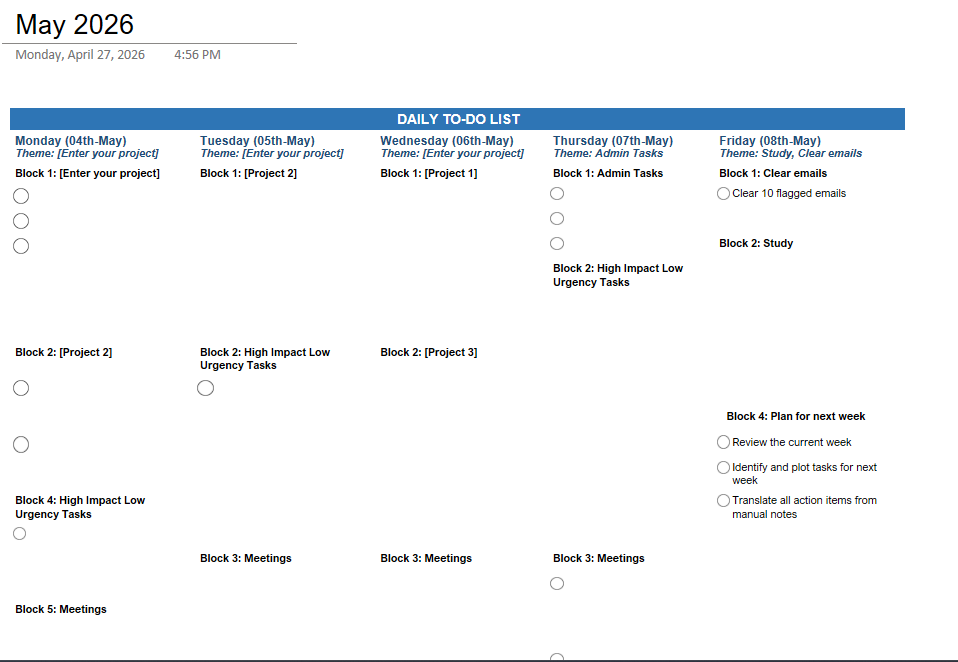
The number of tasks that I had at hand was eventually distributed across six weeks. Mind you, this is my third month of tracking consistently, and I still have 40% of the previous tasks pending, along with the new ones.
The Collapse
So did I suddenly become a task master now that I had a template to work with? Umm, no. Of course not. If all it took was a task tracker to let go of the toxic traits that were holding me back, every single person today would be successful. The demon of procrastination eventually caught up with me, and I spiralled into anxiety, sleepless nights, stress breaking out in my skin and low-grade misery I couldn't shake. I worried that I might still be this close to another major escalation happening due to the delay that had occurred. The days when anxiety would hit me like nobody's business, I just couldn't focus on the tasks listed in front of me. It was extremely hard to divert my mind towards something else.
As I saw my plate piling up, I also started complaining to my manager about how hard it was to manage everything alone. I had no team member to delegate the tasks, no tools to automate anything. On top of this, my manager decided to add more tasks to my plate, which created this tension in my chest whenever I would speak with him. All I could say to him was that it would take time, and I could not commit. It is always important to push back if you have a lot on your plate, but my fear of failing at the new tasks came out due to the fact that I was already trying to finish up my long-pending tasks, which should have been targeted long ago. Of course, I couldn't reveal that to him, but it created this tense situation where we kept playing tug of war, and eventually I had to agree on somewhat flexible timelines.
But I kept going. I kept moving tasks around wherever necessary, and I refused to stop the momentum. The fear of not turning into my mother and the potential job loss was enough of a push to keep tracking. Someone said in a podcast recently, "I am using procrastination to delay my own happiness". That sentence sat down on my chest and didn't move for weeks. Self-sabotage is what I was subconsciously aiming for to feel miserable and have a justification to complain. But what good has ever come out of this?
In the middle of everything, I finally got my long-awaited promotion. I was now a Senior Manager.
This promotion was extremely important as it meant my husband could have an opportunity to quit his job and focus on his health for some time. I knew that I had to stop bad-mouthing my leaders now in front of my team members. I was scared of being ratted out to my leaders.
But, boy, oh boy, did I stop nagging about my bosses in front of my colleagues? No.
I think the drive to talk behind my boss's back primarily originated from the need to feel important and provide an excuse for some of my colleagues to reach out to me and talk. I felt truly pathetic at this realisation. In Hindi, we have this phrase "aadat se majboor", which translates to "compelled by habit". Again, I was repeating the same patterns that I had witnessed far too many times being exhibited at home. Being unable to stop bitching or badmouthing is the single most negative trait I have witnessed from my mom. She would even badmouth me behind my back, even if that meant lying to keep the story going.
Eventually, I did apologise to my leaders because they, of course, knew what was happening on the ground, and I was honestly very tired of keeping up with the shenanigans!
Also read - Why We Keep Repeating the Same Mistakes: The Difference Between Regret and Repentance.
The Compounding Effect
It was really hard at first, but I started keeping all conversations neutral. Even if I didn't have anything to say, I didn't. On a recent 1x1 with a colleague, I caught myself heading toward complaining about my manager — and stopped. I was going in that direction when I was being questioned on clarity, and I knew it was my manager's fault for not providing the clarity. But I opted to take the high road instead and simply stated facts without my own prejudice. It felt freeing to be honest. It was the first conversation in months where I went home with no guilt or fear.
A similar instance occurred when an old colleague of mine visited my current office for some work just a few days ago. He was looking for gossip, and I could have given him some spicy news and lamented about my bosses. But something stopped me. This time, I took a good few seconds to think before I opened my mouth. I reminded myself of what I am trying to change here and the why behind it. It felt liberating to realise that the colleague had nothing on me.
I am not saying bitching about someone is bad. It's an outlet for pent-up emotions, and sometimes saying it out loud helps you see things in a different light. Now I chose to do it only with my husband and no one else.
I still use the same OneNote template from above for tracking my tasks, along with some other methods that I have figured out work well for me without making me feel overwhelmed. Sometimes, I complete every single task in a particular week. Sometimes I don't. What matters is completing "something" from the list while acknowledging that I still have the remaining tasks, instead of constantly worrying if I have left something unread in my mailbox. I hate unknowns, and I hate unpredictability. Knowing what I have on the plate gives me a sense of clarity and allows me to prioritise certain tasks over the rest.
If a post on the actual systems I use to track tasks would be useful, drop a comment.
If this helped you even in a teeny tiny way, you can support my writing with a coffee ☕, completely optional.
Don't forget to subscribe as well to receive my articles directly as part of the newsletter. 🙂
Thanks for reading. See you in the margins.