Five Eye-Opening Books I Read in 2025 and the Lessons They Taught Me

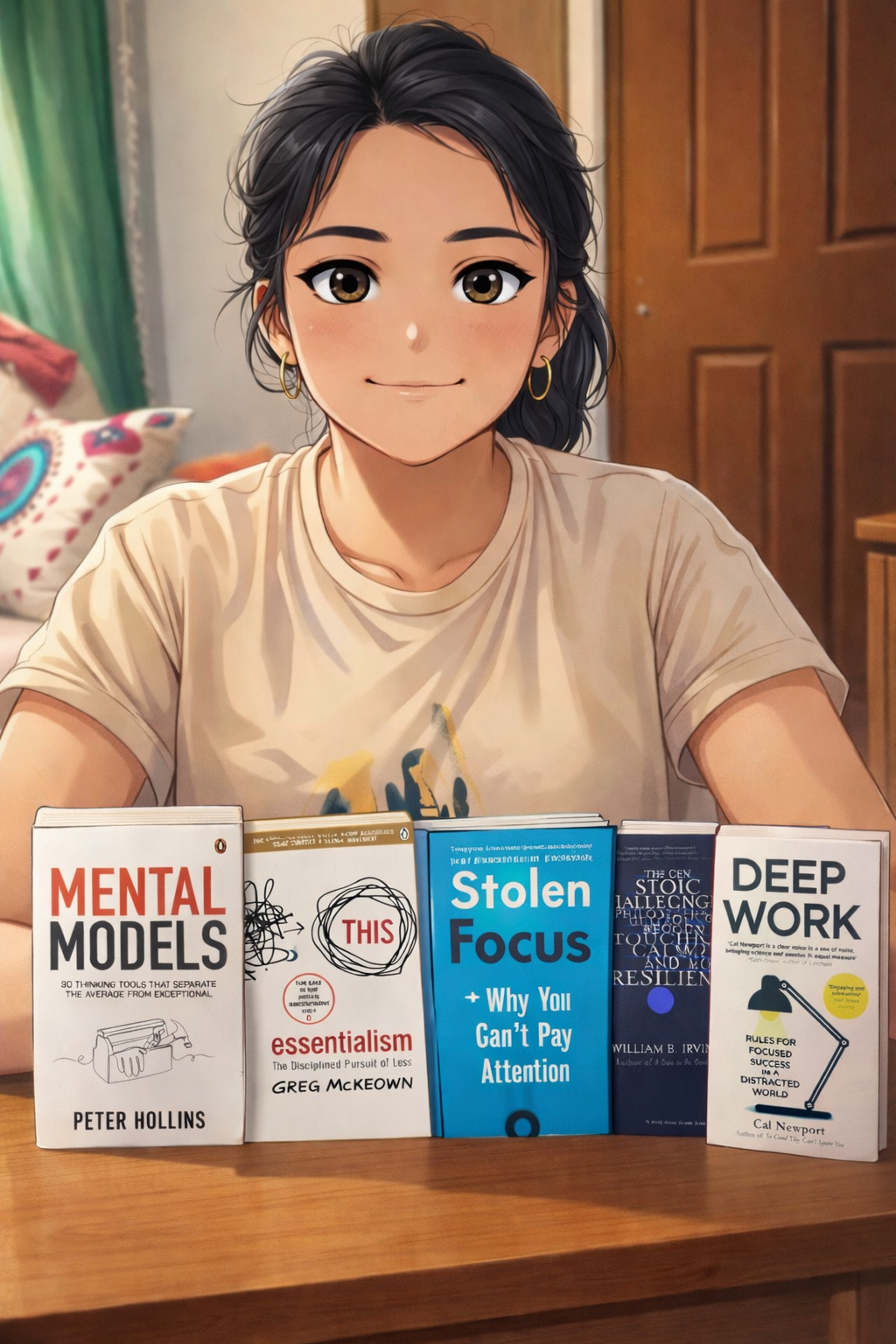
Last year, I set sail on a life-changing journey with the help of five books. After completing a book, I always check online to see if the books I read changed anyone else's life. However, most only mentioned the purpose of the book or lessons from the first few pages, which made me wonder if they had really finished the book to claim some benefit from it.
Through this article, I want to share the actual lessons that I implemented in my life to make it a little better.
Stolen Focus by Johann Hari
In this book, Johann delves into the causes of our attention deficit, which is nearly a pandemic in today's world. Stemming from his own inability to stop spiralling into doomscrolling, he set out to research why we cannot control ourselves to stop scrolling.
The information made me feel disgusted with the tech industry. Understanding the reason behind infinite scrolling and algorithms that feed continuous content was enough for me to deactivate my Instagram account. I was one of the millions addicted to scrolling without noticing the passage of time. There were times when I would unlock my phone without noticing, whenever I was bored. YouTube and Instagram took up 3-6 hours of my time every single day. That resulted in serious consequences. I started losing my attention, forgetting things, and couldn't focus on studying or reading for more than 30 minutes. I became impatient to check other people's updates. Most importantly, I couldn't handle my emotions; they were all over the place.
The fast food trend, the rise in financial and emotional stress, and the lack of play for children are other core issues highlighted in the book.
As I began to understand the different causes and the industries built to steal my attention, it forced me to pause and question: My scrolling allows these companies to thrive at the expense of my attention and focus. Do I really want to sell my attention to these companies, or do I want to put it to use in my goals that actually matter?
I am still working on regulating Netflix and YouTube, but I have control over Instagram and Facebook, which feels like a huge win already.
The key lessons I implemented from this book are:
- Regulated social media use by restricting it to my laptop on weekends, with a timer.
- Prioritised whole foods 90% of the time and exercised consistently for natural dopamine release.
- Completely stopped using buy-now-pay-later options.
The Stoic Challenge by William B. Irvine
The author starts and ends the book with two real-life examples, which I appreciate, but I couldn’t relate to them, as they came from a position of relative privilege and structural support.
That aside, certain portions of this book helped me understand stoicism quite well. To put it simply, stoicism is about focusing on what you can control and letting go of what you can’t, so life’s ups and downs don’t throw you off balance.
William encourages readers to embark on Stoic adventures and let go of the lazy self that has become a common persona for many of us. One of the chapters that hit me hard was on embracing failure. The most important lessons are hidden in failure. It gives you clues to become better—something you might not get if you keep succeeding. He also touches upon comfort zones and why it's necessary to practice toughness training. I love this line from the book: "Experiencing too much comfort will reduce your capacity for experiencing pleasure." He also talks about death in his last chapter, which I am still not comfortable wrapping my head around, but it feels like a necessary read.
The key lessons I implemented from this book are:
- Accepting rejections and setbacks, because nothing is worse than not trying and blaming others.
- Although I don't purposefully embark on Stoic adventures, I try to keep my emotions in check when a setback occurs. It takes practice, but it helps to breathe and remind yourself that every situation is temporary.
- Cutting back, or trying to cut back, on Netflix and YouTube so I can truly enjoy the videos when I watch them in my free time, instead of watching them every day on autopilot.
- Even when I receive the happiest news, I try to meet it with steadiness. Things will go right or wrong, and it’s important to take in both happiness and sadness in equal measure, without experiencing either too intensely.
If you like what you read here, you can support my writing with a coffee ☕, completely optional.
Mental Models (MM) by Peter Hollins
If I had to suggest one book to read from all five, it would be this one. This is a quick read, but best read twice to fully grasp and remember the mental models you want to implement. This book is a life hack. It helped me change my thought process across many areas of my life almost instantly.
Some of the mental models I applied and benefited from:
- Stay within the 40-70 per cent: Peter explains why it is necessary to intentionally consume less information while avoiding overgeneralization. To arrive at any decision, you only need to have 40-70 per cent of the information. I always felt underconfident showcasing my knowledge and experience because I believed one needs to be an expert to speak. This MM helped me change my earlier logic, gain confidence in what I already knew, and make personal decisions faster than I naturally would.
- Ignore "Black Swans": A black swan event is not the norm. Think of it like a rare natural disaster that happens infrequently. However, it should not affect how you live, because it is not a recurring or normal circumstance. It is okay to consider worst-case scenarios, but it’s important to return to reality and ask whether they are likely to occur.
- Separate Correlation from Causation: We generally confuse correlation and causation when trying to find answers. Believing that if two events have similar patterns or behaviours, one must be causing the other to happen is wrong. Using the “Five Whys” method helps determine root causes rather than correlating unrelated patterns. I have been unlucky when it came to meaningful friendships. Every friendship ended in some way or another. It made me wonder if there was something wrong with me or my behaviour that my friendships never lasted. This mental model helped me go beyond the surface and identify the causes. It turned out each ending had a different reason—some my fault and some theirs but none related.
- Avoid Thinking Like an Expert: We tend to overlook basic things when we think like experts while solving problems. It is important to step back from the expert chair and think like a novice who knows nothing about the topic. This helps in identifying the finer details and sometimes even a critical error that may otherwise go unnoticed. I now go over the projects that I lead from a newbie's perspective to help see things that I would otherwise skip for the bigger picture. This helped me close a couple of critical pending tasks that I might otherwise have missed, and could have led to serious issues.
Also read - What I Counted as Achievement in 2025—Even When It Didn’t Look Like One
Deep Work by Cal Newport
It took me a while to complete this book, as there were certain portions I found boring. Nonetheless, some of the tips Cal shares about performing deep work and why it’s important in this distracted world are worth implementing.
Some of the lessons I implemented:
- Cal categorises social media and digital media as network tools to bring them under one umbrella. He asks us to evaluate the true need for these tools in our lives and how much value they add to our primary goals. For example, if one justifies using Facebook to stay connected with friends, is it really true? How much of Facebook do we really use to keep friendships meaningful? Is it helping any of our personal goals? If the answer is no, ditch it or reduce the time spent. I evaluated all the apps I use, and identified which ones are truly needed at times (like YouTube for study materials). It’s also important not to overuse them beyond their intended purpose. Writing down the reasons and the goals they support helped me set boundaries with these tools well.
- I also started scheduling my deep work hours after observing when I can go into a flow state. Those hours typically produce the best results. This became evident with the recent promotion I received.
- I started identifying shallow work that would eat up my time and didn’t add value to my overall work, but still had to be done. I requested an additional resource to support me on such tasks. With this one addition, I can now focus on more strategic aspects of my role.
- This is still hard for me, and many of us are in the same boat. Cal advises us to embrace boredom and, if needed, schedule it in our calendar. Boredom is the key to creativity and identifying solutions to any problem. We have become so uncomfortable with boredom that we dread it. I try to do nothing for at least 5 minutes here and there in a day, and I plan to gradually increase it.
Essentialism by Greg McKeown
This book opened my eyes to how I was working and why I was drowning in it. It also emphasises doing less but focusing on essential, meaningful work. The famous line, "If it's not a straight yes, then it's a no", originated from this book. This book provides a lot of practical tips on how to make this work in our personal lives and careers, and they have proved beneficial to me in many ways:
- I opted out of additional work I was looped into that was good for visibility but not essential. This helped me focus completely on my real work.
- I reviewed all the goals that were set out for the annual calendar. I had 19—yikes! I managed to prioritise and focus on only three goals, which in turn had a cascading effect on fulfilling a few other goals.
- Before adding more tasks to my plate, I started asking myself the trade-off I am willing to make from my existing tasks to fit in the new one. This helped me keep only the important tasks on my plate without becoming overwhelmed. Learning to say no to certain projects or certain activities that I would typically say yes to out of obligation released a lot of pressure and anxiety from me.
This was quite a lengthy read, but I hope some of these learnings resonate with what you need in your life to turn it around. If that's a yes, don't hesitate to pick up the books and see what shifts for you.
Don't forget to subscribe as well to receive my articles directly as part of the newsletter. 🙂
Thanks for reading. See you in the margins.